Introduction
When selecting fiberglass reinforced plastic (FRP) grating for industrial platforms, walkways, and chemical processing areas, understanding the product specifications is the foundation of a safe, cost-effective installation. Engineers, procurement managers, and facility operators must evaluate multiple parameters — from material composition and dimensional tolerances to load-bearing capacity and fire resistance — before choosing the right product.
This comprehensive FRP grating specification guide covers everything you need to know: material properties, standard dimensions, load ratings, span tables, and the key differences between molded and pultruded grating. Whether you are reviewing an FRP grating data sheet for the first time or comparing bids from multiple suppliers, this technical reference will help you make an informed decision.
By the end of this article, you will understand what goes into a complete set of grating specifications, how to interpret load rating data, and which ASTM standards govern FRP grating performance in industrial applications.
What Is an FRP Grating Specification?
A grating specification is a formal document — typically provided by the manufacturer as a data sheet or submittal — that defines the physical, mechanical, and chemical properties of a fiberglass grating product. It serves as the contractual reference between buyer and seller, ensuring the delivered product matches the engineering design requirements. The frp grating specification is the authoritative source for all technical decisions related to selection and installation.
A complete product specification covers the following categories:
| Specification Category | What It Defines | Why It Matters |
|---|---|---|
| Material Specifications | Resin type, glass reinforcement, filler content, fire retardant additives | Determines chemical resistance, strength, weight, and flame spread rating |
| Dimensional Specifications | Panel size, thickness, mesh pattern, bearing bar spacing, open area percentage | Affects load capacity, weight, and suitability for pedestrian vs. vehicular traffic |
| Mechanical Specifications | Load ratings, deflection limits, ultimate strength, modulus of elasticity | Ensures the grating can support design loads with acceptable deflection |
| Fire & Safety Specifications | Flame spread index (ASTM E84), self-extinguishing properties, slip resistance | Compliance with building codes and workplace safety regulations |
| Standards Compliance | ASTM, ANSI, NEMA, ISO references | Certifies that the product meets industry-recognized performance benchmarks |
The key specifications to look for depend on your application. For chemical plants, resin type and corrosion resistance are paramount. For mezzanines and platforms, load ratings and deflection limits take priority. For outdoor installations, UV resistance and weatherability become critical. Always cross-reference the data sheet with your project's engineering drawings and design criteria.
Key FRP Grating Material Specifications
Resin Types in FRP Grating Specifications
The resin system is the single most important component in any FRP product data sheet. It determines the grating's chemical resistance, operating temperature range, fire performance, and UV stability. The three most common resin types specified for fiberglass grating are:
- Polyester Resin — The standard economic choice for general industrial applications. Offers good mechanical strength and moderate chemical resistance. Suitable for indoor use and environments with mild chemical exposure. Typical flame spread rating: Class C (ASTM E84).
- Vinyl Ester Resin — The preferred resin for corrosive environments. Provides excellent resistance to acids, alkalis, bleaches, and organic solvents. Used extensively in chemical processing plants, pulp and paper mills, and wastewater treatment facilities. Typical flame spread rating: Class B or Class A with additives.
- Phenolic Resin — The premium choice for fire-critical applications. Offers the lowest flame spread and smoke development indices. Mandatory in offshore oil platforms, mines, and tunnel applications where fire safety is paramount. Typically achieves Class A (flame spread index ≤ 25).
Beyond resin type, the FRP grating material specifications should also state the glass content percentage (typically 30–50% by weight for molded grating, 50–65% for pultruded), the type of glass reinforcement (E-glass or ECR-glass for enhanced corrosion resistance), and whether UV inhibitors or fire retardant additives are included.
Glass Reinforcement and Fillers
FRP grating material specifications also define the reinforcement architecture. Molded grating uses randomly oriented chopped strand mat and continuous glass roving, creating an isotropic structure with balanced strength in both directions. Pultruded grating uses continuous glass roving aligned longitudinally, giving higher strength in the pultrusion direction but lower cross-directional strength.
Fillers such as calcium carbonate or alumina trihydrate may be added to reduce cost or improve fire performance. The data sheet should list the filler type and maximum percentage, as excessive filler can reduce mechanical properties and long-term durability.
Standard FRP Grating Dimensions and Thicknesses
One of the most critical sections of any grating product data sheet is the dimensional data. Standard FRP grating dimensions vary by manufacturing method (molded vs. pultruded), but most manufacturers follow industry-standard panel sizes and thickness ranges.
Common Panel Sizes and Mesh Configurations
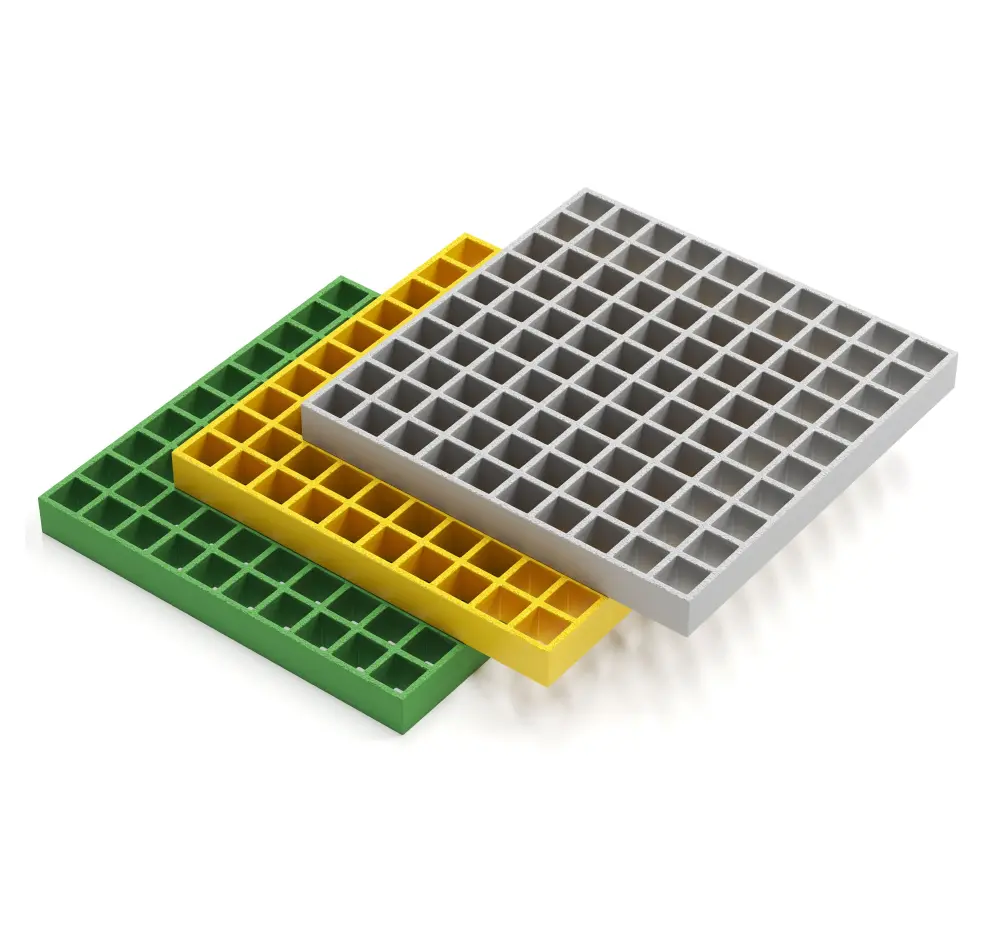
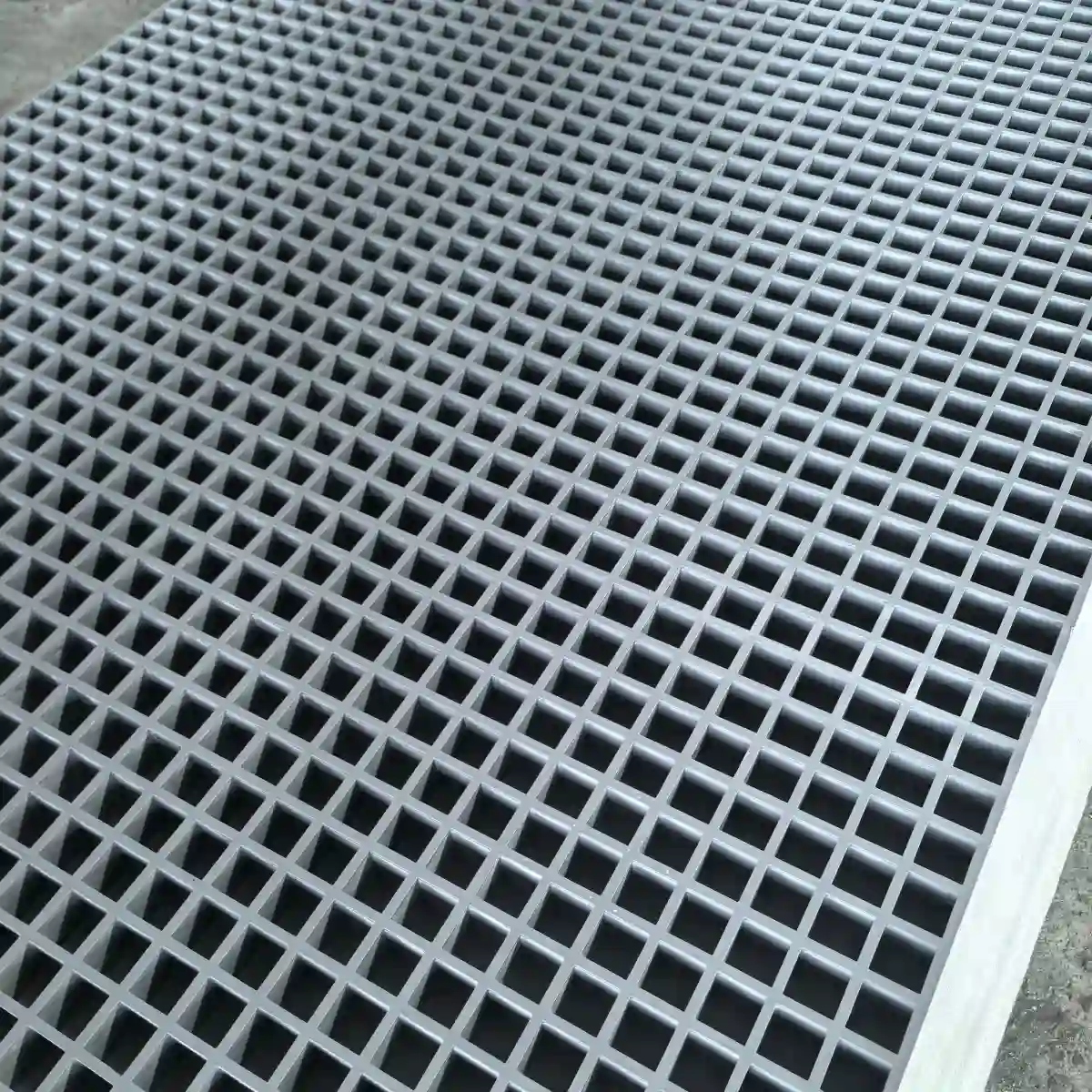
Molded FRP grating is typically manufactured in standard panel sizes of 4 ft × 8 ft (1220 mm × 2440 mm) and 4 ft × 12 ft (1220 mm × 3660 mm). The mesh configuration is defined by the spacing between bearing bars and cross bars, commonly specified as 1.5 in × 1.5 in (38 mm × 38 mm) or 2 in × 2 in (51 mm × 51 mm) centers. The open area ratio — typically 60–70% — is calculated from the mesh spacing and bar thickness.
Pultruded FRP grating uses a different dimensional system. Panels are built from individual bearing bars spaced at standard centers of 1.5 in, 2 in, or 3 in, with cross bars or tie bars connecting them. Panel widths are typically 3 ft or 4 ft, with lengths up to 20 ft or more depending on the manufacturing capability.
| Grating Type | Standard Panel Size | Common Mesh/Spacing | Thickness Range | Open Area |
|---|---|---|---|---|
| Molded FRP Grating | 4 ft × 8 ft (1220 × 2440 mm) | 1.5 in × 1.5 in (38 × 38 mm) | 1 in, 1.5 in, 2 in (25, 38, 51 mm) | 60–65% |
| Molded FRP Grating | 4 ft × 12 ft (1220 × 3660 mm) | 2 in × 2 in (51 × 51 mm) | 1 in, 1.5 in, 2 in (25, 38, 51 mm) | 65–70% |
| Pultruded FRP Grating | 3 ft × 20 ft (914 × 6100 mm) | 1.5 in centers | 1 in, 1.5 in, 2 in (25, 38, 51 mm) | 55–65% |
| Pultruded FRP Grating | 4 ft × 24 ft (1220 × 7320 mm) | 2 in or 3 in centers | 1.5 in, 2 in (38, 51 mm) | 60–70% |
Thickness Options and Bearing Bar Spacing
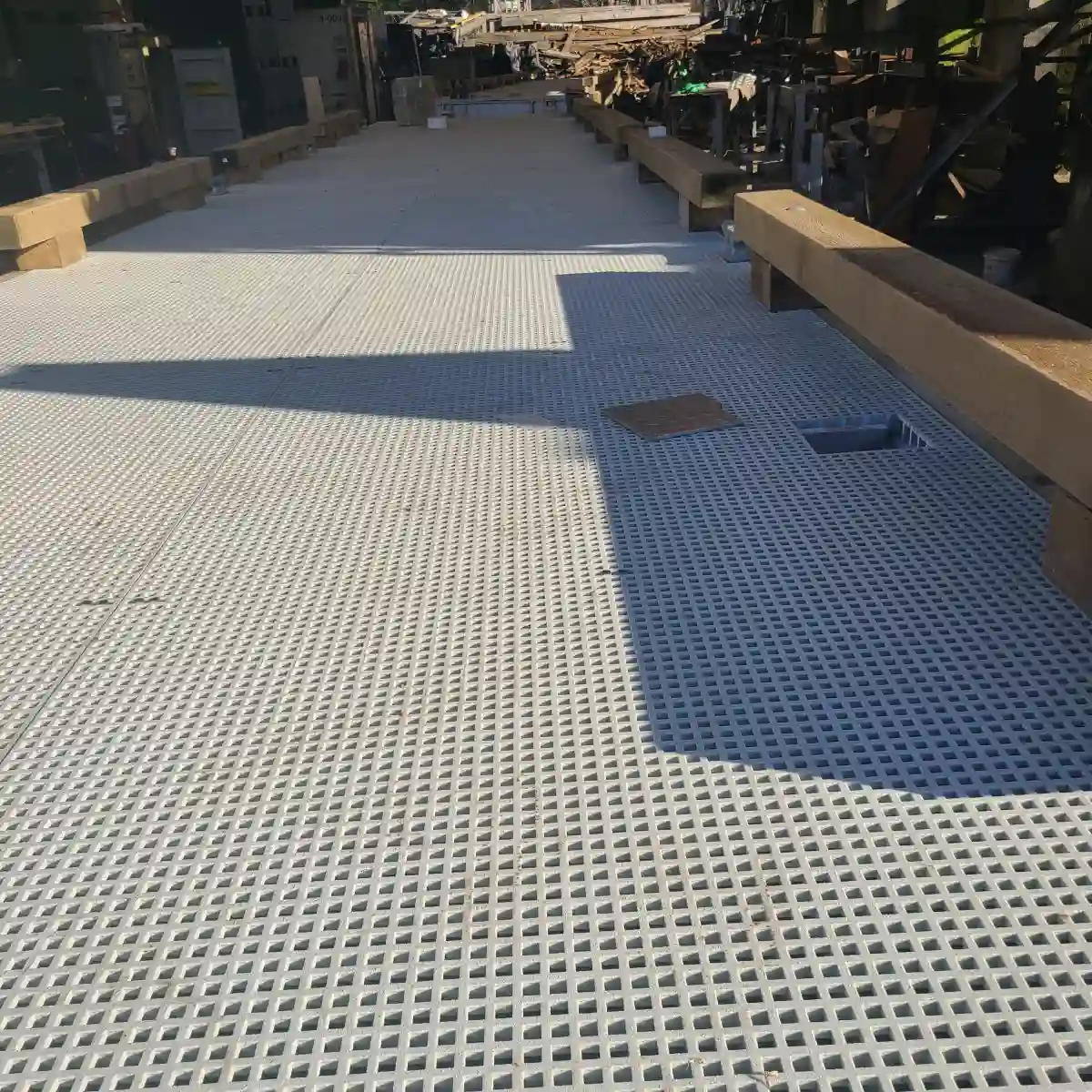
Standard dimensional options for thickness directly affect load capacity. A 1-inch thick molded grating is suitable for pedestrian walkways and light duty platforms. A 1.5-inch thick grating handles industrial foot traffic and light vehicle loads. Two-inch thick grating is designed for heavy industrial applications, including forklift traffic and equipment platforms.
For pultruded grating, the bearing bar depth (height) is the primary dimensional variable. Common bar depths include 1 in, 1.5 in, 2 in, 2.5 in, and 3 in. Deeper bars provide proportionally higher load capacity but also increase weight and material cost. The bearing bar thickness also varies, typically from 0.19 in (4.8 mm) to 0.375 in (9.5 mm), affecting both strength and open area.
When specifying dimensions, always include tolerances. Standard manufacturing tolerances for FRP grating are ±1/8 in (3 mm) on panel length and width, and ±1/16 in (1.5 mm) on thickness. These tolerances are important for fit-up during installation, especially when grating must align with steel supports and cutouts for equipment penetrations.
FRP Grating Load Ratings and Span Specifications
Load rating data is arguably the most important part of any FRP grating product specification. Engineers use this information to verify that the selected grating can safely support the intended loads without exceeding allowable deflection. FRP grating load rating specifications typically present data in tabular format, showing maximum allowable loads for each span configuration at specific deflection limits.
Understanding Load Rating Tables
A standard load rating table from FRP grating load rating specifications includes the following parameters:
- Clear Span — The distance between supports, measured center-to-center. Common spans range from 6 in to 48 in for molded grating, and up to 72 in for pultruded grating.
- Load Rating — The maximum uniformly distributed load (UDL) or concentrated load that the grating can support. This is typically expressed in pounds per square foot (psf) or kilopascals (kPa).
- Deflection Limit — The maximum allowable deflection, usually specified as a fraction of the span length (e.g., L/100, L/150, L/200). For FRP grating, L/100 is the most common design limit, though some applications require stricter limits.
- Safety Factor — The ratio of ultimate load to allowable load. Industry standard is 2:1 for pedestrian loads and 3:1 for vehicular loads, though project specifications may require higher factors.
To use a load rating table, start with your design span. Find the row for that span in the table, then read across to identify the load capacity at your chosen deflection limit. For example, a 1.5-inch thick molded grating at a 24-inch span with L/100 deflection might be rated for 250 psf uniformly distributed load — sufficient for most industrial walkway applications.
Deflection Limits and Safety Factors
Deflection is a serviceability criterion, not a strength criterion. Even though FRP grating may not fail structurally at a given load, excessive deflection can cause discomfort for pedestrians, damage to equipment, or accumulation of debris. The frp grating span specification must therefore consider both strength and stiffness.
Typical deflection limits used in any FRP grating span specification:
- L/100 — Standard industrial walkways and platforms
- L/150 — Mezzanines and areas with sensitive equipment
- L/200 — Public access areas and pedestrian bridges
- L/250 — Areas with strict deflection requirements (e.g., grating supporting piping systems)
The safety factor in fiberglass grating specifications is typically calculated from ultimate strength tests per ASTM D4385. Most manufacturers design to a minimum safety factor of 2:1 based on ultimate capacity. However, for critical applications like crane walkways or emergency egress routes, a 3:1 or higher safety factor may be specified.
Molded vs. Pultruded FRP Grating Specifications
One of the most common questions engineers face is choosing between molded and pultruded FRP grating. While both products are made from fiberglass and resin, their manufacturing processes produce fundamentally different mechanical properties, which are reflected in their respective product specification documents.
| Specification Parameter | Molded FRP Grating | Pultruded FRP Grating |
|---|---|---|
| Manufacturing Process | Compression molded in a heated press | Continuous pultrusion through a heated die |
| Standard Thickness | 1 in, 1.5 in, 2 in | 1 in, 1.5 in, 2 in, 2.5 in, 3 in |
| Maximum Span | 24–48 in depending on thickness | 36–72 in depending on bar depth |
| Glass Content | 30–50% by weight | 50–65% by weight |
| Strength Orientation | Isotropic (equal in both directions) | Anisotropic (stronger in pultrusion direction) |
| Open Area | 60–70% | 55–70% |
| Weight | 3.5–6.5 lb/ft² | 2.5–5.5 lb/ft² (for equivalent strength) |
| Cutting & Fabrication | Easy — can be cut with standard tools | Requires cut-off saws; bar ends need sealing |
| Best Applications | Walkways, platforms, trench covers | Long-span applications, heavy loads, mezzanines |
Molded grating specifications typically show lower load ratings at equivalent thickness because the randomly oriented glass fibers provide isotropic but lower overall strength. The advantage is that a molded grating spec guarantees equal performance in both panel directions. Pultruded grating specifications show significantly higher load ratings in the pultrusion (longitudinal) direction but lower ratings transversely, meaning the grating must always be oriented with bearing bars perpendicular to supports.
When comparing molded vs. pultruded products, pay close attention to the maximum span lengths. Pultruded grating can typically span 50–100% farther than molded grating at the same thickness, making it the preferred choice for mezzanine floors and equipment platforms where support beams are widely spaced.
Industry Standards and ASTM Specifications for FRP Grating
Any credible FRP grating product specification must reference the applicable industry standards. These standards ensure that the product has been tested, classified, and manufactured according to consistent, repeatable criteria. Understanding these standards helps you compare product data from different manufacturers on an apples-to-apples basis.
Primary ASTM Standards for FRP Grating
The standard specifications per ASTM include the following key standards:
| ASTM Standard | Title | What It Specifies |
|---|---|---|
| ASTM D4385 | Standard Practice for Classifying FRP Grating | Classification system by resin type, glass content, and manufacturing method |
| ASTM E84 | Standard Test Method for Surface Burning Characteristics | Flame spread index and smoke developed index (Class A, B, or C) |
| ASTM D6109 | Standard Test Methods for Flexural Properties of FRP Grating | Flexural strength, modulus, and deflection testing procedures |
| ASTM D790 | Standard Test Methods for Flexural Properties of Unreinforced Plastics | Alternative test method for flexural properties of the grating material |
| ASTM D2563 | Standard Practice for Classifying Visual Defects in FRP | Acceptance criteria for visual imperfections in molded grating |
| ASTM D792 | Standard Test Methods for Density of Plastics | Density and specific gravity measurement |
Other Industry Standards
In addition to ASTM, FRP grating specifications may reference the following standards:
- ANSI/NAAMM GR-1 — The Metal Bar Grating Manual (includes FRP grating load tables and design guidelines, though this standard primarily addresses metal grating)
- NEMA RE 1 — National Electrical Manufacturers Association standard for FRP grating used in electrical applications
- OSHA 1910.23 — Occupational Safety and Health Administration requirements for walking-working surfaces, including grating
- ISO 9001 — Quality management system certification for the manufacturing facility
What industry standards apply to FRP grating specifications? The short answer is that ASTM D4385 is the primary classification standard, ASTM D6109 governs load testing, and ASTM E84 governs fire performance. A complete product data sheet will reference all three, plus any project-specific codes such as IBC (International Building Code) or NFPA (National Fire Protection Association) requirements.
When reviewing a manufacturer's data sheet, always verify that the stated ASTM standards are current (check the year suffix) and that the test results are certified by an independent third-party laboratory. Self-certified data should be viewed with caution unless the manufacturer has a documented quality assurance program.
How to Read an FRP Grating Specification Sheet
An FRP grating specification sheet can contain dozens of data points, making it challenging to quickly identify the information most relevant to your project. Here is a step-by-step approach to reading and interpreting any fiberglass grating data sheet.
Step 1: Identify Product Type and Resin System
The first section of any specification sheet identifies whether the product is molded or pultruded grating, along with the resin system (polyester, vinyl ester, or phenolic). This determines the grating's chemical compatibility, temperature limits, and fire rating. Verify that the resin type matches the chemical exposure conditions of your installation environment.
Step 2: Review Physical Dimensions
Check the declared standard FRP grating dimensions: panel length, width, thickness, bar spacing, and open area percentage. Compare these against your project drawings to ensure the grating fits the support structure. Pay attention to the bearing bar direction, especially for pultruded grating where strength is directional.
Step 3: Examine Load Tables
Locate the load rating table. Find your design span on the left column, then read the corresponding load capacity at your chosen deflection limit. The load rating specifications should clearly state whether the loads are uniformly distributed (UDL) or concentrated, and what safety factor was used. Remember that FRP grating load tables typically show allowable loads at L/100 deflection — if your project requires a stricter limit, the allowable load must be reduced proportionally.
Step 4: Check Fire and Safety Ratings
Look for the ASTM E84 flame spread index and smoke developed index. Class A (flame spread 0–25) is required for most building code applications. Also check slip resistance ratings if the grating will be used in wet or oily environments — many data sheets include a silica carbide grit top surface option for enhanced traction.
Step 5: Verify Standards Compliance
The data sheet should list all applicable ASTM, ANSI, or NEMA standards. Cross-reference these with your project specifications. If the specification sheet does not reference any standards, that is a red flag — request certified test reports from the manufacturer before approving the product.
Step 6: Check Special Features and Options
Many FRP grating product data sheets include optional features such as:
- UV-resistant surface veil for outdoor installations
- Conductive or anti-static additives for electrical environments
- Fire retardant additives meeting Class A or Class B requirements
- Color options for safety zoning or visual identification
- Wear-resistant grit top surface for slip resistance
By following these six steps, you can quickly evaluate any fiberglass grating data sheet and determine whether the product meets your project requirements. If any data is missing or unclear, request the manufacturer to provide a completed specification sheet with all fields filled before proceeding with procurement.
Conclusion
Understanding how to read and interpret product specifications is essential for selecting the right FRP grating for your industrial application. From material composition and standard FRP grating dimensions to load ratings and span configurations, every parameter in the data sheet serves a purpose in ensuring safe, durable performance.
To recap, here are the key takeaways for evaluating any FRP grating product specification:
- Resin type determines chemical resistance and fire performance — choose polyester for general use, vinyl ester for corrosive environments, and phenolic for fire-critical applications.
- Dimensions including thickness, panel size, and bearing bar spacing must match your support structure and loading requirements.
- Load ratings should be verified at your design span with the appropriate deflection limit and safety factor.
- Molded vs. pultruded — molded offers isotropic strength and easy fabrication; pultruded delivers higher load capacity and longer spans.
- ASTM standards provide a consistent basis for comparing products from different manufacturers — always check for D4385, D6109, and E84 compliance.
Always request a complete FRP grating specification sheet from your supplier and verify that all data points are filled in, tested by a third-party laboratory, and current. By mastering the art of reading product specifications, you will avoid costly procurement mistakes and ensure your installation meets both safety requirements and performance expectations for years to come.
If you need assistance interpreting a specific product specification or comparing load ratings for your project, consult with a qualified FRP grating manufacturer or structural engineer who specializes in fiberglass-reinforced plastic products.